Identity theft when flat hunting in Berlin: how to protect your documents
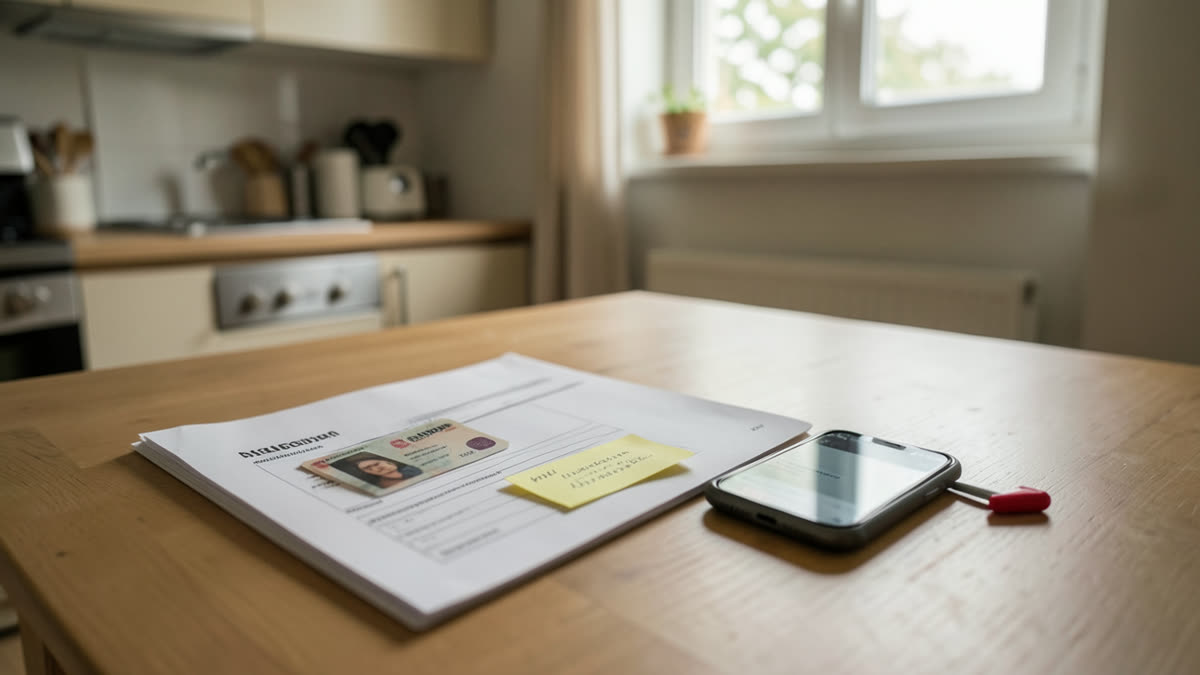
Not every fake flat listing is after your money. Some only want your documents: ID copy, Schufa report, payslips, bank statements. With that package, a lot can be done in your name, and you often only notice weeks later when the reminders arrive. In Berlin, where a decent flat gets hundreds of messages, many people send their full application folder to anyone who replies. That is exactly what these criminals count on. Here is how the trick works, what to hand over when, and what to do if it already happened.
How the trick works
The listing looks great: nice photos, fair price, good location. Your message gets a quick, friendly reply, often by email or WhatsApp rather than through the portal. Before there is any viewing, you are asked to send your complete documents “for pre-selection”. Then it goes quiet, or the requests keep coming: one more bank statement, a selfie holding your ID, a “verification” on a video call.
A particularly nasty version: you are asked to verify yourself via Video-Ident (the video identification banks use to open accounts) “for the lease” or “for the deposit account”. In reality you are opening a bank account that the criminals then use for fraud or money laundering. Police and consumer advice centres keep warning about this scam. A landlord won’t send you a Video-Ident link. If you take out a deposit guarantee (Mietkautionsbürgschaft) yourself, pick the provider yourself and go straight to its website, not through a link from the chat.
What criminals do with your documents
- Loans and buy-now-pay-later: with an ID copy, payslip and bank statement, an application to an online shop or loan broker looks convincing.
- Contracts in your name: phone plans, electricity, streaming or mail-order on invoice. The goods go to another address, the bill comes to you.
- Bank and online accounts: bank accounts, crypto exchanges or payment services later used for fraud. In the worst case the police investigate you first.
- Other people’s flat applications: scammers apply for flats with your documents, or use your details in new fake listings to look real.
- Resale: complete data sets with ID and proof of income get traded and resurface months later.
Red flags: stop here
- Full documents before any viewing, while it is still unclear who the landlord is.
- No name, no property management company (Hausverwaltung), no address, just a free email account or a mobile number.
- They want to move off the portal right away, to WhatsApp, Telegram or private email.
- Requests for Video-Ident, a selfie with your ID or a photo of the back of your ID.
- Questions about your tax ID (Steuer-ID), social security number, online banking login or TANs. No landlord ever needs these.
- Time pressure: “today only”, “two slots left”, “whoever sends first gets the viewing”.
- A price clearly too low for the size and area. More typical patterns are in Rental scams in Berlin: 7 tricks.
What to send, and when
German data protection authorities recommend a step-by-step approach, and it is a good one to follow. For the first message and the viewing, your name and contact details are enough. The Selbstauskunft (tenant self-disclosure form) and your income range fit once you say after the viewing that you want the flat. Proof such as payslips and a Schufa report comes when the landlord wants to give you the flat. Your bank details only with the lease.
In practice many landlords ask earlier, and in Berlin it is tempting to send everything at once. A good compromise: have your PDF ready, but only send it once you have seen the flat or at least know who is behind the listing. With a property management company you can check the name, the Impressum (legal notice on their website) and the phone number. With a private landlord, asking about the last service charge statement (Nebenkostenabrechnung) helps; real owners usually answer that calmly. What the full folder should look like is covered in Rental application documents.
Schufa: the credit report for landlords, not the data copy
Don’t send a landlord the free data copy you can request under Art. 15 GDPR. It is meant for you and contains far more than a landlord needs, such as your accounts, contracts and previous addresses. For landlords, Schufa offers the BonitätsAuskunft (credit report), which shows only the essentials and usually costs money. More in Schufa, proof of income & co..
ID copy: black out and label it
For the German Personalausweis (ID card), § 20 of the ID Card Act (PAuswG) says a copy may only be made by the holder or with their consent, and it must be clearly and permanently recognisable as a copy. The recipient may not pass it on to third parties. According to the Federal Ministry of the Interior, you may black out data the recipient doesn’t need. German passports fall under an equivalent rule in the Passport Act (PassG); foreign passports and IDs aren’t covered by German law, but the same precautions make sense. Here is how:
- Black out: the access number (CAN, the six-digit number at the bottom right of the front of a German ID card) and the serial number. If you also send the back, black out the machine-readable zone at the bottom, which repeats the serial number. Photo, name, date of birth and validity stay readable.
- Label it: write across the copy “Copy, only for flat application with [name of management company] on [date]”. You can also add a watermark with free apps or PDF tools.
- Ideally send only the front. A landlord rarely needs the back with your address, which is in your self-disclosure anyway.
- Passport or non-German ID: black out the document number and the machine-readable zone, and label it as a copy in the same way.
- No selfie with your ID and no video call where you hold your ID up to the camera. That is identity-verification material, not an application.
A copy labelled with the recipient and date is almost worthless to a fraudster. A clean, unmarked, unredacted ID copy is a gift.
Payslips and bank statements: less is more
- Payslip: black out tax ID, social security number, IBAN, employee number and the church tax marker. Keep name, employer, period and net pay readable. A landlord usually doesn’t need individual components like bonuses or allowances.
- Bank statement: only if it is really requested, and then black out everything except salary and rent. Your IBAN and balance don’t belong in an application.
- Redact properly: a black box in some PDF tools can simply be moved aside. Export the redacted page as an image, or print it, black it out with a marker and scan it again.
- Never hand over online banking logins, TANs or photos of your bank card.
If your documents are already out there
Take a breath. A sent ID copy doesn’t automatically mean something will happen. But if you realise the listing was fake, or you are already getting unknown invoices or reminders, act quickly:
- File a police report (Strafanzeige). In Berlin you can do this online via the Internetwache (online police station) of the Berlin police, or at any police station. Keep all messages, emails, listing links and screenshots. The report helps you fight false claims and entries later.
- Tell your bank, especially if you shared your IBAN, statements or even login details. If in doubt, have cards and access blocked. The German blocking hotline 116 116 works around the clock (+49 116 116 from abroad), but not every bank takes part, so call your bank directly if yours doesn’t.
- Request your free Schufa data copy under Art. 15 GDPR and check for unknown enquiries, accounts or contracts. Check again after a few weeks. You can also request free information from other credit agencies such as CRIF or Creditreform Boniversum under Art. 15 GDPR.
- Report false entries: write to Schufa that you are a victim of identity misuse and attach a copy of your police report. You have the right to have wrong data corrected or deleted (Art. 16 and 17 GDPR).
- Lost ID: if the card itself is gone, report it to the Bürgeramt (citizens’ office) or the police and have the online ID function blocked (also via 116 116 or at the Bürgeramt). For a mere copy that isn’t necessary; a copy can’t be blocked. For a foreign passport, contact your embassy.
- Change your passwords, especially email, online banking and shopping accounts, and switch on two-factor authentication everywhere. Whoever controls your email can take over almost any other account.
- Report the listing to the portal where you found it so others don’t fall for it.
If you receive invoices or reminders for contracts you never signed, don’t pay. Object in writing, refer to your police report and ask for the contract documents. The Verbraucherzentrale Berlin (consumer advice centre) can help. If a company refuses to correct your data, you can also complain to the Berlin Commissioner for Data Protection and Freedom of Information.
Why Berlin is hit so hard
Where many people compete for few flats, decisions are made fast and under pressure. Newcomers don’t yet know how things usually work and often search from abroad without being able to view anything. On top of that, there are many furnished short-term offers where contact happens only by email anyway. That makes it easy for criminals. Your best defence is a fixed order: check who is offering, then view, then send documents, then sign, then pay. What to check during the viewing itself is in the viewing checklist.
How Kiezfinder handles this
On Kiezfinder you post a free search order with your preferred Kieze (neighbourhoods), budget and move-in date. Kiezfinder only covers Berlin. You don’t need an ID copy or payslips to post a search order. Finders who know your neighbourhoods tip you off when a flat becomes free. Only then do you send your documents, directly to the landlord or management company, not to the finder. You only pay a finder fee if you actually sign a lease. If anyone asks you for money or ID documents before that, report it in the chat or via the contact address in our privacy policy.
Note: this article is not legal advice. For specific questions, the Verbraucherzentrale Berlin, a tenants’ association (Mieterverein) or a lawyer can help.
Part of the guide: Moving to Berlin →